
Half marathon training plan for beginners: 16 weeks to your first 13.1
A 16-week beginner half marathon training plan with real mileage, phase breakdowns, and a free personalised generator. Run your first 13.1 the right way.

The half marathon is the distance that gets people hooked on racing. Long enough to feel like a genuine achievement, short enough that the training doesn't swallow your life. At 13.1 miles, it asks more of you than a 10K but gives you back a finish line feeling that most runners describe as the moment they understood what this sport is actually about.
It also happens to be my own personal favorite race distance.
If you're preparing for your first one, the training looks different from what experienced runners do. You need more time, a gentler ramp, and a plan that starts where you actually are; not where you'd like to be. This 16-week plan (which you can download nearer the bottom of this post) is built for exactly that.
My training plan generator creates a personalised plan around your exact inputs: race distance, surface, elevation, current weekly mileage, training days, and goal time. Name your race, dial in the details, and get a plan built for you — free for all members. → Build your training plan
Running training plan generator — road & trail, 5K to 100M
Build a personalized running training plan around your actual race date, current mileage, and experience level. Road and trail, any distance.
 Alastair Dixon
What a beginner half marathon plan actually needs
The half marathon is primarily an aerobic event. The training should reflect that. Most of your weekly running volume (around 80%) should be easy, fully conversational effort. If you can't hold a sentence, you're running too hard.
For a beginner, the long run is the cornerstone of the week. Everything else exists to support it. The long run builds time on feet, trains the body to run efficiently when fatigued, and gives you confidence that you can cover the distance. It also takes the longest to recover from, which is why the rest of the week is structured around it.
The other thing a beginner plan needs is time. More time than most people expect. Six weeks of base building before any real intensity is introduced isn't padding; it's what allows the quality sessions in weeks 7 through 12 to actually land on a body that can handle them.
How long does it take to train for a half marathon?
The valid range is 8 to 20 weeks. The right answer depends almost entirely on your current weekly mileage and running consistency.
For a true beginner running around 15 miles a week, 16 weeks is the honest recommendation. It gives you a full six-week Base phase to build aerobic volume before intensity is introduced, six weeks of Build to develop race-specific fitness, two Peak weeks at maximum load, and a proper two-week taper. Compressing that into 12 weeks means either skipping the base or cutting the taper, both increase injury risk and leave fitness on the table.
If you have 20 weeks, use them. A longer plan means a more gradual ramp and less risk of hitting weeks 10–12 already beaten up. If you only have 12 weeks and you're already running 25+ miles a week consistently, a shorter plan can work — but that's not a beginner situation.
Can you train for a half marathon in 2 months? Eight weeks is the minimum my plan range allows, but it's only realistic if you're already running regularly and have covered 10K distances before. For most true beginners, two months isn't enough time to build the aerobic base and the long run distance safely.
Is this plan right for you?
Who it's for
This plan suits runners who are currently running around 15 miles a week across three or four sessions, are comfortable covering 5–6 miles without stopping, and have never followed a structured training plan before. You don't need race experience. You do need to be running consistently before week 1 starts.
The plan uses run/walk intervals through the Base phase (six full weeks of them) before transitioning to continuous easy running in the Build. If that sounds right for where you are, this plan will get you to the finish line.
Who it's not for
If you're currently not running at all, this plan starts too fast. You need to build a base first before a 16-week half marathon plan makes sense. I'm working on a dedicated couch to half marathon training plan for exactly that starting point — check back for that if you're earlier in the journey.
If you're already running 30+ miles a week and have half marathon experience, this plan will feel too conservative. My training plan generator will size the plan correctly for your current mileage.
The four-phase structure
Every plan follows the same periodization: Base, Build, Peak, Taper. For a beginner over 16 weeks, the phases are weighted toward the base end — that's where the endurance foundation is laid.
Base wks 1–6, Build wks 7–12, Peak wks 13–14, Taper wks 15–16.
Base (weeks 1–6): run/walk and aerobic foundation
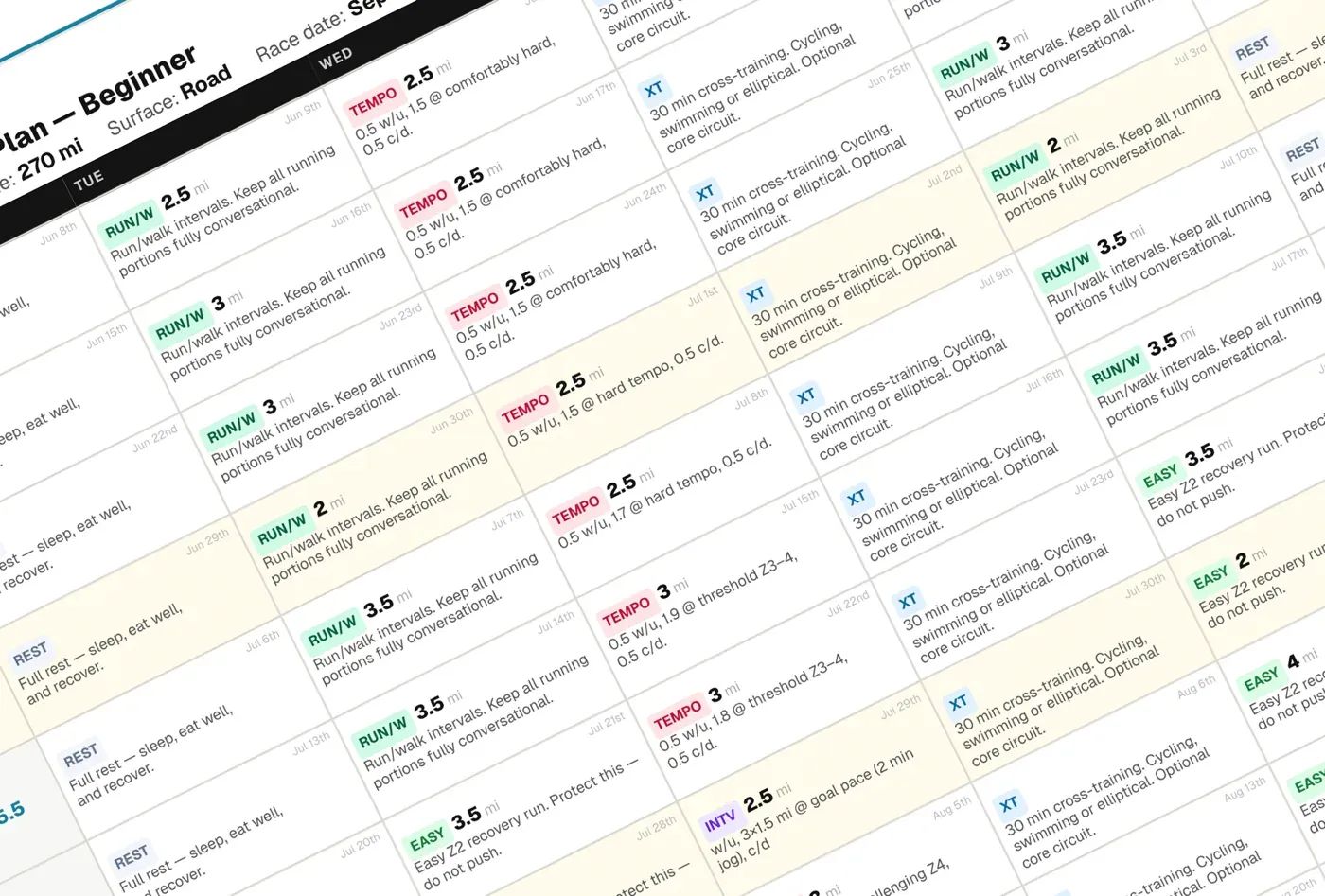
Six weeks of Base. No continuous running expected; the plan uses run/walk intervals on Tuesday and Friday, a tempo session on Wednesday, cross-training on Thursday, and a long run on Sunday. Monday and Saturday are rest days.
Weekly volume builds from 12.5 miles in week 1 to 16.5 miles in week 6, with a step-back in week 4 (back to 12.5 miles). Long runs climb from 5 miles to 6.5 miles across the Base phase.
The run/walk format is not a compromise. It's a specific training approach that lets you accumulate more time on feet than continuous running would allow at this stage, with less fatigue and injury risk. The running portions should be fully conversational throughout.
Build (weeks 7–12): continuous running and quality sessions
Week 7 is where things change. Run/walk drops out and continuous easy running replaces it on Tuesday and Friday. Intervals appear for the first time in week 8: 3×1.5 miles at goal pace with 2-minute jog recovery.
Build volume climbs from 17 miles in week 7 to 20.5 miles by week 11, with a step-back in week 8 (13.5 miles). Long runs progress from 7 miles in week 7 to 8.5 miles by week 12. Tempo blocks get longer and harder, moving from threshold Zone 3–4 in week 7 to close-to-race effort by week 11.
Week 12 is the final Build week and includes the longest interval session of the plan: 3×2 miles at goal pace with 2-minute jog recovery. The long run reaches 8.5 miles.
Peak (weeks 13–14): highest mileage
Two weeks at maximum volume and intensity. Week 13 hits 20 miles, week 14 hits 22.5 miles — the highest weekly total in the plan.
Week 14 includes the biggest interval session: 2×3 miles at goal pace with 3-minute jog recovery. That's 6 miles of goal-pace work in a single session, which is the sharpest quality day of the entire 16 weeks. The long run peaks at 9 miles in week 14.
If week 14 feels brutal, that's correct. You're meant to arrive at the taper tired.
Taper (weeks 15–16): trust the process
Volume drops sharply. Week 15 falls to 15.5 miles, with a 6-mile long run and a shorter tempo session at goal race pace. Week 16 is four easy 2-mile runs, two full rest days, then race day.
The taper is two weeks, not one, because 16 weeks of training needs adequate recovery before race day. Most runners feel worse during taper with heavier legs, flat energy, and random aches. This is normal. The fitness is there. The taper is letting it consolidate.
Key sessions in a beginner half marathon plan
Run/walk intervals (weeks 1–6)
Tuesday and Friday in the Base phase. All running portions are fully conversational Zone 2 — if you're breathing hard, the walk breaks aren't long enough. The walk portions are recovery, not failure. Distance builds from 2.5 miles in week 1 to 3.5 miles in week 6.
Easy runs (weeks 7 onward)
Once the Base phase ends, Tuesday and Friday become continuous easy Zone 2 runs. The instruction in the plan is specific: "protect this, do not push." Easy days that drift into moderate effort blunt the quality sessions scheduled for Wednesday. A well-cushioned daily trainer is what you want for these days — my best cushioned running shoes and best daily trainer running shoes guides cover the options worth looking at.
Tempo runs (Wednesday)
Wednesday is the primary quality session in the Base phase and alternates with intervals in the Build. Tempo structure is consistent throughout: 0.5-mile warmup, a sustained effort block, 0.5-mile cooldown.
The tempo block starts at 1.5 miles at comfortably hard in week 1 and progresses to 2.5 miles at close-to-race effort by week 11, then 1.6 miles at goal race pace in the taper. Effort is Zone 3–4: harder than easy, not a sprint. You should be able to think clearly but not hold a conversation.
Intervals (weeks 8, 10, 12, 14)
Intervals appear four times in the plan, all in the Build and Peak phases. The progression is deliberate:
- Week 8: 3×1.5 mi at goal pace, 2-min jog recovery
- Week 10: 4×1 mi at goal pace, 90s jog recovery
- Week 12: 3×2 mi at goal pace, 2-min jog recovery
- Week 14: 2×3 mi at goal pace, 3-min jog recovery
The reps get longer and the total goal-pace volume increases across these four sessions. The recovery is part of the session — don't cut it short.
Cross-training (Thursday)
Thirty minutes of cycling, swimming, or elliptical throughout all 16 weeks. This session maintains aerobic fitness without adding impact stress to legs that are already handling a higher load than they're used to. Don't skip it and don't make it a hard effort — easy cross-training on Thursday protects Sunday's long run.
The long run (Sunday)
The cornerstone of the whole plan. Always easy Zone 2, always conversational. The long run is not a test — it's a training stimulus. Running it faster than easy effort increases recovery time without adding meaningful fitness benefit at this stage.
Long runs in this plan go from 5 miles in week 1 to a peak of 9 miles in week 14. That's 9 miles for a 13.1-mile race, which is intentional. You don't need to run race distance in training. You need to run long enough that 13.1 miles feels like a manageable extension of what you've already done.
Long run progression
Here's the full arc, week by week:
- Wk 1: 5 mi
- Wk 2: 5.5 mi
- Wk 3: 5.5 mi
- Wk 4: 6 mi (step-back week overall, long run continues to build)
- Wk 5: 6 mi
- Wk 6: 6.5 mi
- Wk 7: 7 mi
- Wk 8: 7 mi (step-back week)
- Wk 9: 7.5 mi
- Wk 10: 8 mi
- Wk 11: 8 mi
- Wk 12: 8.5 mi
- Wk 13: 8.5 mi
- Wk 14: 9 mi (peak)
- Wk 15: 6 mi (taper)
- Wk 16: Race day — 13.1 mi
The long run never drops during the Build and Peak phases, even on step-back weeks. The step-back comes from reducing the midweek volume, not the long run. That's deliberate — long run continuity is what drives the endurance adaptation.
The step-back week: why weeks 4, 8, and 12 matter
Every 4th week pulls back to roughly 75% of the previous week's volume. Week 4 drops to 12.5 miles from 14 miles in week 3. Week 8 drops to 13.5 miles from 17 miles in week 7. Week 12 drops to 16 miles from 20.5 miles in week 11.
This is non-negotiable in the plan structure. Aerobic adaptation doesn't happen during the hard weeks — it happens during recovery. Running hard week after week without a step-back compounds fatigue rather than building fitness. The step-back week is where the body catches up to the training stimulus.
You'll probably feel good on step-back weeks. That's the point. Don't use that energy to add extra miles.
What about couch to half marathon?
If you're currently not running at all, this plan isn't the right starting point. The week 1 sessions assume you can already run/walk for 2.5 miles and cover a 5-mile long run at easy effort. If that's beyond where you are right now, you need a couch-to structure first.
I'm building a dedicated couch to half marathon training plan that starts from zero and works up to the half marathon distance. It's a different plan architecture — sessions measured in time rather than distance in the early weeks, a slower progression, and a longer overall runway. Check that page when it's live if you're earlier in the journey.
Download the plan
My training plan generator creates a personalised plan around your exact inputs: race distance, surface, elevation, current weekly mileage, training days, and goal time. Name your race, dial in the details, and get a plan built for you — free for all members. → Build your training plan
Running training plan generator — road & trail, 5K to 100M
Build a personalized running training plan around your actual race date, current mileage, and experience level. Road and trail, any distance.
Alastair DixonWhy a personalised plan beats a static one
The plan above is built around a runner doing 15 miles a week. If your current mileage is 20 miles, the week 1 volume will feel easy and the peak weeks won't be as challenging as they should be. If you're at 10 miles a week, week 1 might be too aggressive.
That's the limitation of any static plan. It fits one assumed starting point.
My training plan generator takes your actual current mileage and builds the progression from there. It sets the starting volume correctly, scales the peak to match your base, and adjusts the long run arc accordingly. It also accounts for how many training days you can commit to; not everyone can train on exactly the days this plan prescribes. And if you have a goal finish time, it assigns specific pace targets to every interval and tempo session.
The plan it produces follows the same Base/Build/Peak/Taper structure, the same session types, and the same long run logic — just calibrated to your actual starting point rather than an assumed one.
FAQ
How long does it take to train for a half marathon?
For a beginner running around 15 miles a week, 16 weeks is the right target. It gives enough time to build the aerobic base before quality sessions are introduced, progress the long run safely to 9 miles, and taper properly without feeling rushed. If you're already running 25+ miles a week and have some race experience, 12 weeks can work. Eight weeks is the absolute minimum and only makes sense if you're already in solid running shape.
Can you train for a half marathon in 2 months?
Two months is 8 weeks, which is the minimum the plan range allows for a half marathon. It's possible if you're already running consistently and have covered 10K distances before. For a true beginner with limited running history, 2 months isn't enough time to build the long run from 5 miles to 9 miles safely while also introducing quality sessions. The injury risk goes up significantly when the ramp is that steep.
How many miles a week should a beginner run for a half marathon?
This plan builds from 12.5 miles in week 1 to a peak of 22.5 miles in week 14. As a rough guide, a beginner half marathon plan should sit in the 15–30 miles per week range across the training block, with peak weeks in the low-to-mid 20s. Running more than that as a beginner isn't necessary and increases injury risk without proportional fitness benefit.
What's a good half marathon time for a beginner?
Anywhere from 2:00 to 2:30 is a solid first-time result. The goal for a first half marathon should be finishing comfortably and running the second half at roughly the same pace as the first — not going out too fast and surviving the back half. A 2:15 finish works out at around a 10:20 per mile pace, which is very achievable on this plan if you train consistently.
The Best Running Shoe Finder 2026
Answer 5 quick questions and get matched to the best running shoe for your training style, ride preference, and foot shape.
Alastair Dixon
If you're unsure what shoes will work best for race day, my shoe finder app is a quick way to narrow it down. For stability-focused options specifically, my best stability running shoes guide is worth a look if you pronate or want more support over the longer distance.
Written by

Subscribe to new posts
reviews, training tips, and thoughtful stories for runners













Member discussion