
10K training plan: 6, 8, and 12 weeks for beginner, intermediate, and advanced runners
10K training plans for every level: 12 weeks for beginners, 8 for intermediate, 6 for advanced. Real mileage, phase breakdowns, and a free personalised generator.

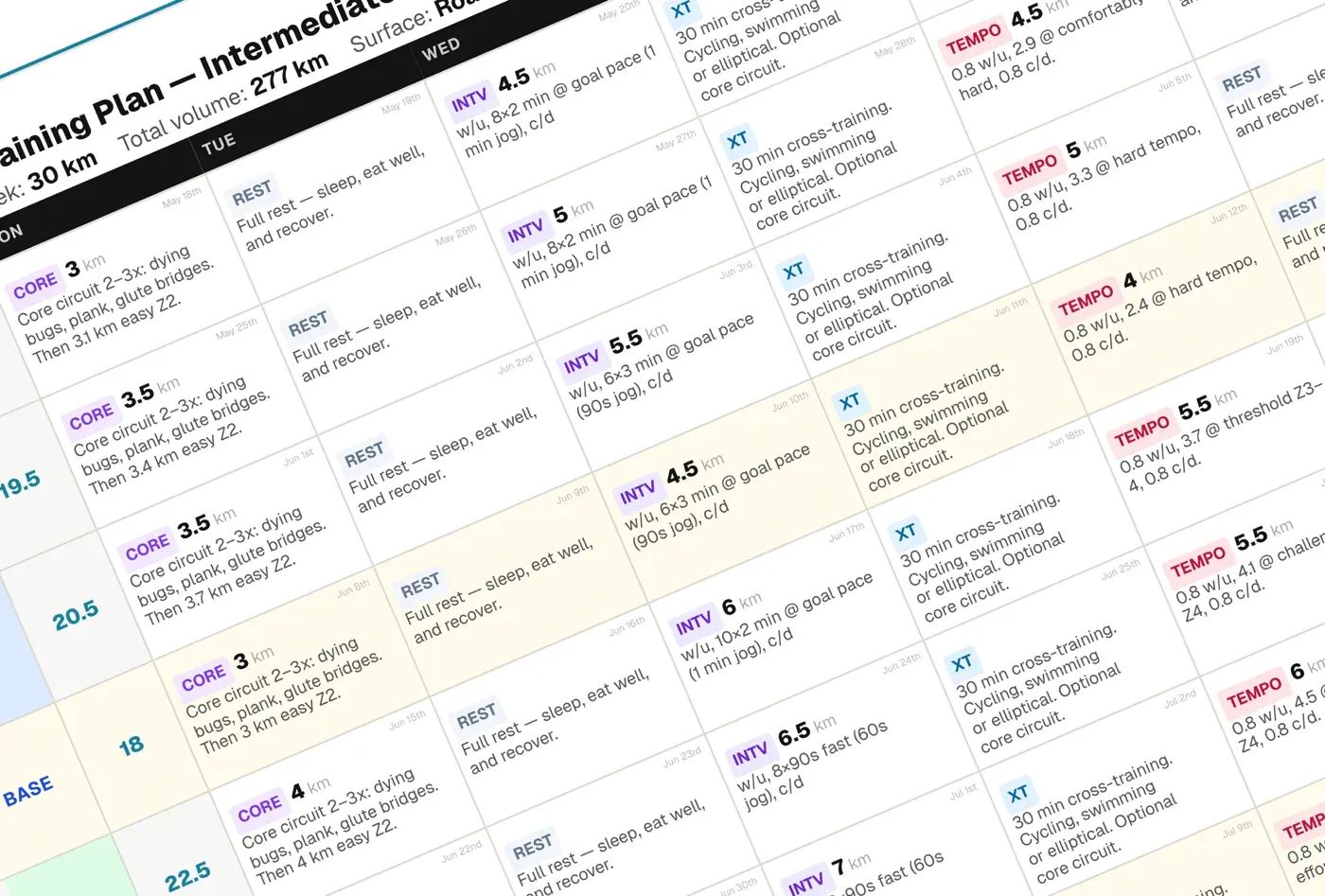
The 10K sits in an interesting place. It's long enough that you can't fake your way through it on fitness alone, and short enough that the training doesn't take over your life. A focused 6-week block can sharpen an experienced runner into race shape. A structured 12-week build can take a beginner from inconsistent running to crossing the finish line with something left.
Some training plans for this distance default to one length regardless of who's running. This article covers all three experience levels with plan lengths that actually match where you are: 12 weeks for beginners, 8 weeks for intermediates, and 6 weeks for advanced runners. Real plans, real numbers, and the reasoning behind the structure.
My training plan generator creates a personalised plan around your exact inputs: race distance, surface, elevation, current weekly mileage, training days, and goal time. Name your race, dial in the details, and get a plan built for you — free for all members. → Build your training plan
Running training plan generator — road & trail, 5K to 100M
Build a personalized running training plan around your actual race date, current mileage, and experience level. Road and trail, any distance.
 Alastair Dixon
What the 10K actually demands from your training
The 10K is a hybrid event. It rewards aerobic fitness (you're on your feet for anywhere from 35 minutes to over an hour) but it also punishes a weak engine at the top end. You need pace, not just endurance.
That means a good 10K plan does two things at once: builds your aerobic base through easy volume, and sharpens your top-end fitness through controlled quality sessions. The ratio matters. About 80% of your weekly running should be easy, conversational effort. The remaining 20% is where the quality work lives: intervals, tempo runs, and the long run.
Get that balance wrong and you're either slugging through junk miles or accumulating fatigue faster than you can absorb it. The plan structure below keeps it dialed.
How long should you train for a 10K?
The valid range is 6 to 14 weeks, and the right answer depends on your current fitness more than anything else.
Beginners need more time. A 12-week plan gives four full weeks of easy aerobic base before any intensity is introduced, which means the quality sessions in the Build phase land on a body that's actually ready for them. Cutting that short and jumping straight into intervals is where a lot of self-coached 10K training goes wrong.
Intermediate runners with an existing base don't need four weeks of easy running before quality starts. Eight weeks is enough: a short Base phase to establish the training week, then straight into a progressive Build.
Advanced runners with consistent high mileage and race experience are already fit. They need race-specific sharpening, not a volume ramp. Six weeks of focused work (Base, Build, Peak, Taper) is the right call. More than that and you're adding fatigue without adding fitness.
Which plan is right for you?
Three plans, three starting points. Here's how to pick the right one.
Beginner — 12 weeks, 194 km total, 18 km peak week
This plan is for runners who are running regularly but haven't done structured training before. You're comfortable covering 15 km a week across a few runs, some of which might include walk breaks.
The beginner plan uses run/walk intervals in the Base phase before transitioning to continuous running in the Build. Quality sessions are shorter and effort-based rather than pace-based. Peak week lands at 18 km, and the long run reaches 8 km before the taper.
Not right for you if: you're already running 25+ km a week consistently. Drop into the intermediate plan instead. If you're also in the market for a first structured training shoe, my best stability running shoes guide is worth a read before you start.
Intermediate — 8 weeks, 183 km total, 29 km peak week
This plan is for runners with a regular weekly routine of around 30 km, some race experience, and a reasonable handle on effort zones. You can run easy without it feeling painfully slow, and you've done something resembling a quality session before, even if it was just a faster parkrun effort.
Three weeks of Base, three weeks of Build, one Peak week, then taper. Quality sessions run from week 1. Peak week is 29 km, and the long run reaches 9.5 km.
Advanced — 6 weeks, 192 km total, 38.5 km peak week
This plan is for runners doing 50+ km a week who want a focused 10K sharpening block. You have a current 10K time you're trying to improve, and you're comfortable with intervals, tempo runs, and running at goal pace effort.
Two weeks of Base, two weeks of Build, one Peak week, then taper. The plan assumes you arrive with the fitness already built; it's doing the race-specific work, not the base work. Peak week is 38.5 km, with tempo blocks reaching 8 km at goal race effort and intervals progressing to 5×5 min at goal pace.
Not right for you if: you're not currently running at least 40 km a week. The week 1 volume and intensity will be too aggressive.
The four-phase structure
Every plan follows the same periodization of Base, Build, Peak, and Taper. The phases shift what kind of stress you're putting on the body. What changes between plans is how many weeks each phase gets.
Base: building the aerobic engine
No intensity in the Base phase. Every session is easy. The point is to establish consistent aerobic volume before adding quality work on top of it.
The beginner plan runs four Base weeks at 15 km per week, with run/walk on Monday, controlled-effort intervals and tempo on Wednesday and Friday, and an easy long run on Sunday. The intermediate and advanced Base phases are shorter (three weeks and two weeks respectively) because those runners are already aerobically developed.
Every 4th week in the beginner and intermediate plans is a step-back recovery week at roughly 75% of the previous week's volume. For the beginner, week 4 holds at 15 km. For the intermediate, week 4 drops to 19 km from 22 km in week 3.
Adaptation happens during recovery, so be aware that skipping the step-back to chase more mileage is one of the most common mistakes in self-coached training.
Build: introducing quality
The Build phase is where the plan gets specific to the 10K. Intervals and tempo runs progress in length and intensity, while easy volume continues to climb.
For the beginner, Build sessions shift from run/walk to core-plus-easy on Monday, with interval and tempo sessions that stay short but get harder. Long runs reach 7 km by the end of Build.
For the intermediate, intervals move from 10×2 min in week 4 to 6×4 min at goal pace by week 6. Tempo blocks grow from 2.4 km at threshold to 5.4 km at close to race effort. Peak Build week is 29 km.
For the advanced, the Build is two weeks and moves fast: intervals go from 10×2 min to 6×4 min at goal pace, and tempo reaches 8 km at close to race effort by week 4. Peak Build week is 37.5 km.
Peak: highest training stress
One to two weeks at maximum volume and intensity. This is where the fitness consolidates.
The beginner peaks at 18 km across weeks 10–11, with long runs at 7.5 and 8 km. The intermediate peaks at 27.5 km in week 7, with a long run of 9.5 km and intervals at 5×5 min at goal pace. The advanced peaks at 38.5 km in week 5, with intervals at 5×5 min at goal pace and tempo at 8 km at goal race effort — the sharpest session in the plan.
If you feel good in the Peak phase, don't add extra sessions. If you feel wrecked, don't panic. Both are normal. The taper is coming.
Taper: trust the process
Volume drops to 22 km across all three plans. Four short easy runs at 3 km each, two full rest days, then race day.
Most runners feel worse during taper, not better. Legs feel heavy, motivation dips, and small niggles that weren't there during training suddenly announce themselves. This is normal. It's residual fatigue lifting, and it doesn't mean the fitness isn't there. The fitness is there. The taper is preserving it.
Key sessions in a 10K plan
Four training days, four session types. Here's what each one does and why it's in the plan.
Easy runs and the 80/20 rule
Monday is a core circuit followed by an easy Zone 2 run. Zone 2 means fully conversational — if you can't hold a sentence, you're running too hard.
This is the session most runners get wrong. Easy runs are not warm-ups for the session you'd rather be doing. They're the session. Around 80% of your weekly volume should sit here. Running easy days too hard is the most common reason runners plateau, because it means they can't actually push hard on quality days.
For the beginner plan, Monday starts as a run/walk in the Base phase before transitioning to a core-plus-easy format in the Build. For intermediate and advanced, Monday is a core circuit followed by 3–8 km easy depending on the week and level.
A well-cushioned daily trainer is what you want for these; my best cushioned running shoes and best daily trainer guides are good starting points if you're due an update.
Intervals — what they look like across the plan
Wednesday is the primary quality session. Intervals start with shorter reps and progress in length as the plan develops.
The beginner plan opens with 8×2 min at goal pace with 1 min jog recovery, moving to 6×5 min by peak week. The intermediate follows the same progression across a compressed timeline, reaching 5×5 min at goal pace in peak week. The advanced plan opens with 8×2 min and peaks at 5×5 min at goal pace with 2-minute recoveries — the longest, hardest interval session of the plan.
If you're running these at genuine goal pace, a tempo shoe is worth the investment for interval days; my best cushioned speed trainers guide has current picks across price points.
The recovery between reps is part of the session. Cutting the jog short to feel tougher is counterproductive; you need the recovery to actually hit the target effort on the next rep.
Tempo runs — comfortably hard, getting harder
Friday is the tempo session: a warm-up, a sustained effort block, and a cool-down. The warm-up and cool-down are consistent at 0.8 km each. The block in the middle gets longer and harder as the plan progresses.
The beginner tempo block starts at 1.6 km at comfortably hard effort and stays controlled throughout. The intermediate moves from 2.5 km at comfortably hard to 4.6 km at goal race effort by peak week. The advanced opens at 5.2 km and reaches 8 km at goal race effort in peak week; sustained at 10K effort for 8 km, which is the sharpest session in the plan.
Tempo effort is Zone 3–4: harder than easy, but not sprint effort. You should be able to think clearly but not hold a conversation. A responsive daily trainer works well here — my best tempo running shoes roundup covers the options worth considering.
Cross-training (Thursday)
Thirty minutes of cycling, swimming, or elliptical, with an optional core circuit. This session maintains aerobic fitness without adding impact stress.
It's not optional and it's not a rest day. At the same time, don't overthink it — 30 minutes on a bike counts.
The long run
Sunday is the long run, and it's always easy, and always Zone 2. The long run is the endurance anchor of the week. It builds time on feet and trains the body to run efficiently when tired.
For a 10K plan, the long run doesn't need to be dramatic. It's not marathon training. The runs are long relative to your daily volume, not long in absolute terms.
Long run progression
All three plans start the long run at 6.5 km in week 1. From there the trajectories separate.
Beginner (12 weeks): 6.5 km for most of the Base and early Build, stepping up to 7 km in week 8, 7.5 km in week 10, and 8 km in peak week 11.
Intermediate (8 weeks): 6.5 km through the Base phase, climbing to 7.5 km in week 4, 8 km in week 5, 9 km in week 6, and 9.5 km in peak week 7.
Advanced (6 weeks): 6.5 km in weeks 1–2, stepping to 7.5 km in week 3, 8.5 km in week 4, and 9.5 km in peak week 5.
None of these long runs are run at goal pace. Easy, conversational, throughout. Save the pace for Wednesdays and Fridays.
The step-back week: why recovery weeks matter
The beginner and intermediate plans both include a step-back recovery week at around 75% of the previous week's volume. For the beginner, week 4 holds at 15 km. For the intermediate, week 4 drops to 19 km from 22 km in week 3.
The 6-week advanced plan is too short for a formal step-back, but the Base-to-Build transition manages the same function: volume and intensity don't spike simultaneously.
This isn't a rest week. It's a recovery week. You're still running, still doing quality sessions, just at reduced volume. The reduced load lets the body process the adaptation stimulus from the previous weeks.
Skip it and you carry compounding fatigue into the Build phase; that's when small issues become injuries.
Download the plans
My training plan generator creates a personalised plan around your exact inputs: race distance, surface, elevation, current weekly mileage, training days, and goal time. Name your race, dial in the details, and get a plan built for you — free for all members. → Build your training plan
Running training plan generator — road & trail, 5K to 100M
Build a personalized running training plan around your actual race date, current mileage, and experience level. Road and trail, any distance.
Alastair DixonWhy a personalised plan beats a static one
The three plans above give you real structure and real numbers. But they're built around assumed starting points: 15 km, 30 km, and 50 km current weekly mileage. If your number is different (say, 22 km or 42 km) neither the beginner nor intermediate plan starts in quite the right place.
That's the core limitation of any static plan. It's calibrated for someone, not for you.
My training plan generator takes your current mileage and builds the volume progression from there. It adjusts the plan length to the weeks you actually have, accounts for the number of training days you can commit to, and (if you're chasing a time goal) assigns specific pace targets to interval and tempo sessions. If you just want to finish, sessions stay effort-based throughout.
The plan it produces covers the same Base/Build/Peak/Taper structure, the same session types, and the same long run arc — just dialed to your actual starting point.
FAQ
How long does it take to train for a 10K?
It depends on your current base. Advanced runners with consistent mileage can be race-sharp in 6 weeks. Intermediate runners with an existing routine need around 8 weeks for a proper Build and Peak. Beginners without structured training yet should allow 12 weeks to develop the aerobic base before quality work is introduced.
How do I train for a 10K in 3 months?
Three months is 12–13 weeks, which maps well to the beginner plan above, or gives an intermediate runner a longer runway with more base-building before the quality work starts. If you're generating a plan through my training plan generator, input your race date and current mileage and it will set the right structure automatically.
Can I train for a 10K on 4 days a week?
Yes, and 4 days is the structure all three plans use: Monday (easy with core), Wednesday (intervals), Thursday (cross-train), and Sunday (long run), with Friday as the tempo session — so technically 4 running days plus one cross-training day. If you need to drop a day, cross-training is the first to go. Never cut the long run or a quality session.
What's a good 10K time?
For a beginner completing their first structured 10K plan, anywhere from 55 to 75 minutes is a solid result. Intermediate runners with some race experience should be targeting 45–55 minutes. Advanced runners with a consistent 50+ km weekly base can aim for sub-45, with sub-40 as a longer-term benchmark.
If you're unsure what shoes will work best for race day, my shoe finder app is a quick way to narrow it down.
The Best Running Shoe Finder 2026
Answer 5 quick questions and get matched to the best running shoe for your training style, ride preference, and foot shape.
Alastair Dixon
Written by

Subscribe to new posts
reviews, training tips, and thoughtful stories for runners













Member discussion