Heart rate training for runners: Train smarter, not harder
Using your heart rate to guide your training can help you run stronger, recover better, and finally get the most out of those "easy runs.”


Running based on heart rate changed everything for me.
I used to push hard on every run, trying to maintain a pace that “sounded fast” or felt productive. Sometimes I’d hit a wall way too soon, and other times, I’d go out too hard on a long run and completely tank by mile 10.
Then I discovered heart rate training, and it gave me the clarity I didn’t know I was missing. With time, it also allowed me dial in my ability to run on RPE with much greater accuracy.
Running training plan generator — road & trail, 5K to 100M
Build a personalized running training plan around your actual race date, current mileage, and experience level. Road and trail, any distance.
 Alastair Dixon
Whether you're aiming to build endurance, increase speed, or make sure your easy runs are actually easy, understanding your heart rate zones gives you a way to measure effort that’s grounded in what your body is actually doing, not just how it feels or how fast you’re going.
👋
Affiliate Disclaimer: 'Alastair Running' is reader-supported, if you purchase gear through links on this site, I may earn a small affiliate commission. Thanks for supporting my work. -Alastair ✌🏼
What is heart rate training?
Let's get some of the basics out of the way. Heart Rate Training (or HR Training) is a way of using your body’s feedback—your actual heart rate—to determine how hard you’re working while you run.
Instead of guessing your effort level, like with Relative Perceived Effort (RPE), or trying to hit a set pace no matter the terrain or weather, heart rate training uses zones based on your individual max heart rate.
These zones help guide your easy runs, your hard efforts, and everything in between.
That means your “easy run” will actually be easy. And when it’s time to go hard, your watch will tell you you’re in the right zone.
Why I recommend training by heart rate
I started using heart rate training while training for my first half marathon. What I didn’t expect was how much it would teach me about restraint—specifically how important it is to keep those recovery runs truly slow.
It made a huge difference in how I felt day to day, and how quickly I bounced back after hard sessions.
Now, I use it year-round, whether I’m training for a race, maintaining fitness, or just enjoying the trails. And it’s especially helpful when:
- Running at altitude or in extreme heat
- Training on hills or off-road trails
- Feeling unusually tired or rundown
In all those scenarios, your pace might slow down—but your effort stays right where it should be.
Alastair’s Top-Rated Running Gear Of 2025, So Far
Road, trail, racing, recovery—the essential running gear I choose to use for my training. These are the products that outperform the competition, right now.
 Alastair Dixon
The 5 heart rate training zones
You’ll need your max heart rate to calculate these zones (we’ll get to that below). These zones are percentages of your max HR.
| Zone | % Max HR | Effort Level | Feels Like / Used For |
|---|---|---|---|
| 1 | 50–60% | Very light | Easy walks, warm-ups, gentle recovery runs |
| 2 | 60–70% | Comfortable | Long runs, base building, aerobic fitness |
| 3 | 70–80% | Moderately hard | Tempo runs, steady effort racing (10K) |
| 4 | 80–90% | Hard | Intervals, VO2 max work, hill repeats |
| 5 | 90–100% | Very hard | Sprint intervals, anaerobic bursts, 5K kick |
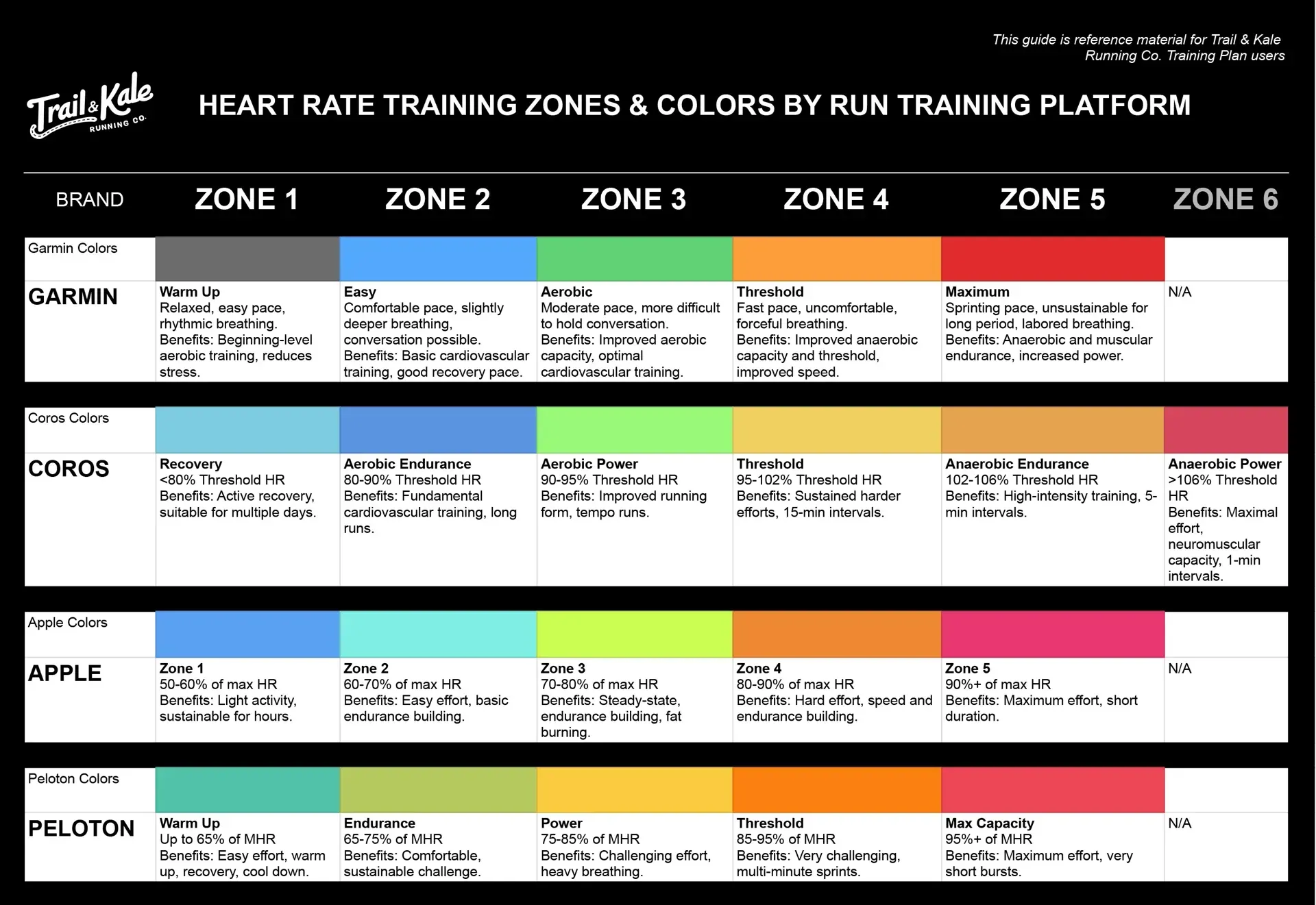
Zones 2 and 3 are where most of your weekly mileage should live. Zone 4 and 5 are for short, focused efforts once or twice a week.
How to calculate your max heart rate
There are three ways to do this:
1. Age-based formula (quick + easy)
- 220 – your age = Max HR (rough estimate)
- A slightly more accurate version: 211 – (0.64 × age) - (a potentially more accurate formula from the HUNT Fitness Study).
2. Field test (more accurate)
- Warm up well
- Run hard for 20 minutes
- Use your highest recorded heart rate as your max
3. Lab test (most accurate)
- A professional VO2 max test at a sports performance center
If you’re just getting started, the formula-based method is good enough to begin with.
What gear do you need?
You don’t need a lab or a chest strap (though those are still great). A GPS running watch with a built-in optical HR monitor will do the trick.
This post is for paying subscribers only
Subscribe to continue reading
Written by